



Ninja Warrior Course Equipment for Commercial Facilities: Planning Guide
A 4,000 sq ft trampoline park outside Austin bolted a three-lane ninja warrior course along its side wall last spring. Nine obstacles per lane, a padded warped wall at the end, a foam landing zone underneath. The build took a crew four days once the steel arrived. By summer the course was running timed heats on Friday nights and pulling a teenage crowd the jump floor had stopped holding. That is the case for ninja warrior course equipment in a commercial room: it reclaims an age group most play centers lose around eleven, and it turns floor space into a competition people come back to beat. It is also easy to get wrong, because a ninja course is not one product. It is a chain of obstacles, and the weakest link decides how the whole thing ages.
What follows is how to think through obstacle selection, lane layout, surfacing, and the equipment specs that separate a course that lasts from one that wobbles by year two.
Ninja warrior course equipment by age group
The single biggest planning decision is who the course is for, because it changes almost every obstacle on it.
A course built for the 5-to-12 crowd runs low. Obstacles sit closer to the mat, the gaps between them are short, and the grip elements are sized for small hands. Think low balance beams, floating steps, a cargo net, a short set of monkey bars, and a warped wall a determined nine-year-old can actually run. The whole point is that most kids clear most obstacles - a course that defeats everyone stops getting repeat attempts.
A course built for teens and adults is a different animal. Taller warped walls, a salmon ladder, cliffhanger ledges, spinning wheels, and ring swings that demand real grip strength and body control. Here the design goal flips: the course should be hard enough that finishing it is an accomplishment worth filming. Many FEC operators split the difference and build two lanes - one scaled for kids and one for the older crowd - off a shared frame, so a family can run side by side.
Height is the lever that ties age to safety. The higher an obstacle sits, the more free height of fall the surfacing below has to absorb, which is why a competition-grade adult course carries a deeper foam pit or thicker matting than a toddler-friendly one covering the same footprint.

A commercial ninja warrior course - the multi-obstacle build Lefunland produces for FEC and gym floors.
Choosing the obstacles
A commercial ninja lane is usually eight to twelve obstacles long, sequenced so the climber alternates between grip, balance, and swing rather than gassing out one muscle group. A common flow moves from an easy warm-up obstacle, into balance elements, through an overhead grip section, into a swing or gap crossing, and finishes on the warped wall.
The obstacles that show up on most commercial builds:
- Warped wall - the signature finish. A curved run-up wall the climber sprints and grabs the top of. Kid heights and adult heights are different molds, not the same wall at two settings.
- Monkey bars and pegboard - overhead grip travel, the core ninja test.
- Cargo net and climbing net - vertical or angled scaling, forgiving enough for younger kids.
- Floating steps and quintuple steps - angled platforms the climber bounces across without stopping.
- Balance beams and rolling logs - low, high-throughput, and popular with the younger lane.
- Ring swings, rope swings, and spinning wheels - gap crossings that reward momentum and grip.
- Salmon ladder and cliffhanger - advanced elements for a course selling difficulty to teens and adults.
The mistake worth avoiding is loading a lane with too many high-difficulty grip obstacles in a row. A course that only elite athletes finish looks impressive in a promo video and sits empty on a Tuesday. Throughput comes from a mix.
Laying out ninja warrior course equipment in the room
Ninja courses are linear, which is both their advantage and their constraint. They love a long wall. A single lane needs a running strip of clear length plus a safe run-off past the warped wall, and the room's ceiling height caps how tall the final wall and any overhead frame can go.
Three layout patterns cover most rooms. A single wall-hugging lane is the cheapest way in and eats the least floor. Parallel lanes - two or three side by side - turn the course into a race, which is what drives group bookings and birthday parties. A wrapping L-shaped or U-shaped course threads a longer obstacle count through an irregular room and works when a straight run will not fit. Custom design is where this gets decided, because the obstacle count, the lane width, and the surfacing depth all get set against the actual dimensions of the space rather than a catalog diagram.
Surfacing is the line item planners underestimate. Under and around the obstacles you need impact-attenuating coverage - foam pit, thick landing mats, or a bonded pour - sized to the fall height above it. On a course selling difficulty, the matting can claim as much floor as the obstacles do, and discovering that after the layout is locked is an expensive surprise.
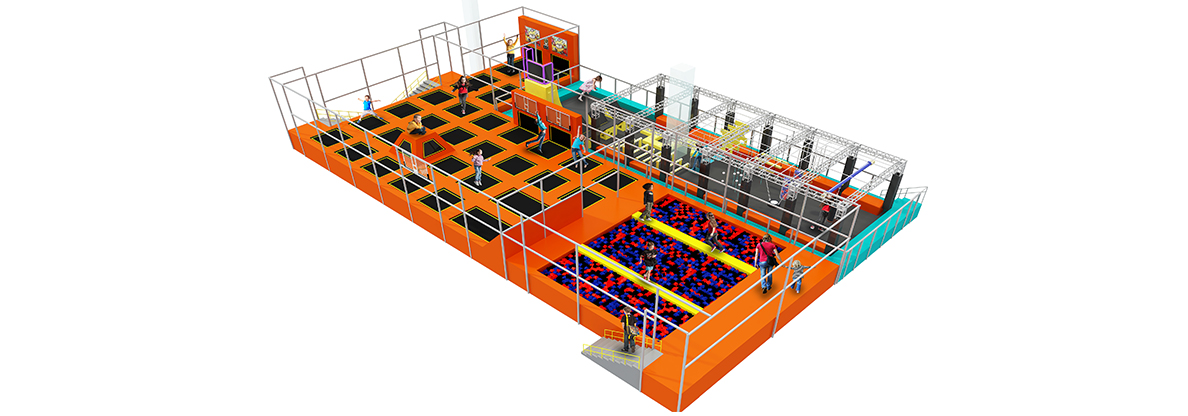
A ninja course lane read as a sequence - grip, balance, and swing obstacles chained end to end.
The steel and padding behind ninja warrior course equipment
A ninja course takes abuse most play equipment never sees. Every obstacle is a person swinging, dropping, and yanking on a frame thousands of times a week. The frame either holds true or it starts to flex, and flex at the joints is where a course goes from tight to sloppy.
Lefunland builds its ninja structures on heavier steel than the imported frames that fill most lower-traffic and residential builds - thicker-walled tube, wider in diameter, and heavier per length. On a ninja frame that extra metal is the difference between a warped wall that stays rigid under a running teenager and one that gives a little more each month. It does not show on opening day. It shows in year two.
The padded elements carry their own material story. Where a ninja course wraps steel in foam - padded rails, covered platforms, the cushioned face of a warped wall - the covering is what meets hands and shins all day. Lefunland wraps those elements in a thicker, tougher PVC skin than the industry norm. The heavier vinyl is the abrasion and tear budget on the parts that get gripped and kicked hardest, and a thin cover is the first place a busy course looks worn.
There is a reason a manufacturer can build to that standard and stand behind it. Lefunland is a principal drafting unit for China's national amusement equipment standards and operates an SGS-authorized testing laboratory that can test and issue inspection reports across the industry, not only for its own products. The company that helps write the standard and runs the lab also builds the course. That background does not make the steel heavier on its own - the material choice does that - but it is why the frame and the padding are built the way they are.
Production and installation
A custom ninja warrior course runs on a 45-day production lead time. That window covers the 3D design sign-off, steel fabrication, foam and PVC padding, powder coating, and a trial assembly at the factory before anything ships. The trial build is the step most buyers do not know to ask about. Catching a warped wall that does not meet its landing at the factory in Dongyang costs nothing. Catching it on your floor costs a crew and a delay.
On site, order matters. The slab and anchor points come first, because a ninja frame transfers real dynamic load into the floor and often into the wall it runs along. The frame goes up next, then the obstacles, then the padding, then the surfacing. A single wall-hugging lane is often a two to four day job for a crew. A larger multi-lane course, or one folded into a full playground fit-out with trampoline and climbing zones, rides along with the wider installation schedule.
What ninja warrior course equipment costs
Ninja equipment sits inside the same factory-direct band as the rest of a Lefunland fit-out, from $10 per sq ft, with the real number driven by obstacle count, difficulty, and how much of the footprint is surfacing. A dense competition course packs a lot of engineered steel and deep foam into a small floor, so its cost per square foot runs high. A simpler kid-scaled lane spread along an existing wall is cheaper per square foot but claims floor in matting either way.
The material-to-price ratio is the part worth sitting with. A frame that is 15 percent cheaper up front but flexing and re-padding in year four is not cheaper - it is the same course twice. Better steel and thicker vinyl do not show in the invoice difference. They show in the operator's P&L starting around month 24, when the honest frame is still taking full traffic and the thin one is on its first repair. Equipment that holds up for seven years under commercial traffic and equipment that holds up for three at half-traffic look identical the day the doors open.
Lefunland has delivered 3,000+ projects across 60+ countries from a 70-acre factory, which is the volume that lets the ninja line stay both fully custom and built to a heavier material standard. For how a ninja course fits alongside jump zones and other attractions, see the trampoline park equipment guide. For the vertical obstacles that pair with a ninja lane, see the commercial climbing wall guide.
Request a factory-direct quote
If you are planning a commercial ninja warrior course - a single wall-hugging lane or a multi-lane competition setup inside a larger playground - Lefunland can take it from 3D design through installation. Email contact@lefunland.com or message the team on WhatsApp at +8613605727866 with your wall length, ceiling height, and the age group you are building for, and to get a factory-direct quote.
