



Commercial Indoor Climbing Walls: Types, Height Limits, and Installation
A 6,000 sq ft family entertainment center outside Denver put a 26-ft auto-belay tower against its back wall last spring. Eight climbing lanes, four themed panels, a steel frame bolted to the slab in two days. The tower now runs a line most Saturdays and pays for a party host on its own. That is the appeal of a commercial indoor climbing wall: it fills vertical space that would otherwise sit empty, and it draws an older kid the ball pit lost three years ago. It is also one of the more misunderstood pieces of equipment an FEC buys, because the wall you see is the small part. The steel, the anchoring, and the certification behind it decide whether the thing is still safe in year seven.
Here is how the category actually breaks down, what the height rules require, and what installation looks like from purchase order to first climber.
Types of commercial indoor climbing walls
Most FEC floors end up with one of four formats, and plenty combine two.
Auto-belay towers are the tall ones. A climber clips into a self-retracting lanyard at the base, climbs, and lets go at the top; the device lowers them at a controlled speed. No staff member holds a rope. That is why auto-belay works for a commercial operation - one attendant can supervise six or eight lanes instead of belaying one climber at a time. The auto-belay units themselves are typically imported devices with their own certification and service intervals, mounted to the top of a steel structure.
Bouldering walls stay low and use no harness at all. Climbers traverse or top out over thick landing mats. Because there is no fall protection beyond the matting, bouldering height is capped low by design, which changes the surfacing requirement rather than removing it.
Interactive and lit walls pair climbing holds with sensors, lights, and a scoring game. Touch the lit hold, score a point, race the clock. These read younger and shorter, and they turn climbing into a timed attraction rather than a sport.
Sculpted feature climbs - spinning pillars, twist columns, and freestanding shapes - work as centerpieces in a larger soft-play zone. They are climbable structure and visual anchor at the same time.
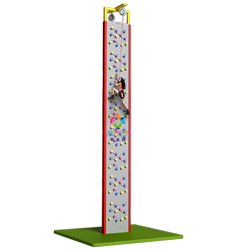
A commercial indoor climbing wall with molded holds and themed panels, built for continuous FEC traffic.
Height limits and what the standards actually require
There is no single national number that says a climbing wall may be X feet tall. The height you can run is a function of the fall-protection method and the standard you build to.
Lefunland certifies its play structures to ASTM F1487 and EN1176, the two frameworks most FEC buyers and their insurers ask for. ASTM F1487 is the US standard for public-use play equipment; EN1176 is its European counterpart. Both treat free height of fall as the governing input. On a bouldering wall the fall is the whole height, so the standard forces a low top-out and a defined depth and area of impact-attenuating surfacing under and around the wall. On an auto-belay tower the lanyard is the primary fall protection, so the structure can go much higher - commonly in the 20 to 30 ft range for indoor rooms - as long as the device rating, the clip-in procedure, and the base clearance all check out.
The practical read for a planner: bouldering buys you a small footprint and cheap supervision but eats floor space in matting. Auto-belay buys you vertical drama and throughput but adds a certified device to your maintenance log. Neither is the "right" height in the abstract. The room dimensions and the age you are selling to set it.
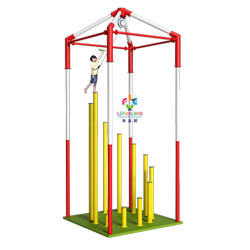
An auto-belay tower format, where a self-retracting lanyard is the primary fall protection rather than staff belaying.
Structural requirements: the steel behind the holds
Climbing loads are not gentle. A wall takes dynamic pull at the holds, the shock of a climber weighting the lanyard at the top, and the same load thousands of times a week. The frame carries all of it.
Lefunland builds its climbing structures on 48mm x 2.2mm steel pipe. Industry-typical imported frames often run 40mm x 1.5mm, which is fine for lower-traffic and residential use. The gap is 0.7mm of wall thickness and 8mm of diameter - invisible on opening day, and the difference between a frame that stays true and one that starts to flex where the panels meet the uprights. On a climbing tower that flex is not cosmetic; the wall face has to stay rigid for the holds to sit where the route setter put them.
The finish matters for a different reason. Lefunland powder-coats to 80+ microns against an industry-typical 40 to 60. Coating thickness is the wall's corrosion and abrasion budget. Hands, shoes, and chalk work a climbing surface harder than almost anything else on an FEC floor, and a thin coat is the first place wear shows.
| Spec | Lefunland | Industry-typical |
|---|---|---|
| Steel pipe (diameter x wall) | 48mm x 2.2mm | 40mm x 1.5mm |
| Powder coating thickness | 80+ microns | 40-60 microns |
| Certification | ASTM F1487 + EN1176 | Varies |
There is a reason a company can be specific about these numbers. Lefunland is a principal drafting unit for China's national amusement equipment standards and operates an SGS-authorized testing laboratory that can test and issue inspection reports across the industry, not only for its own products. The company that helps write the standard and runs the lab also builds the wall. That does not make its steel thicker on its own - the 48mm x 2.2mm spec does that - but it is why the spec sheet reads the way it does.
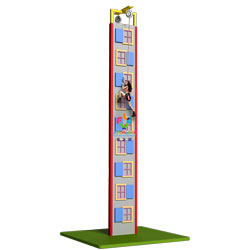
Climbing panels mounted to the steel frame - the structure carries dynamic load thousands of times a week.
Installing a commercial indoor climbing wall
Production runs on a 45-day lead time for a custom climbing structure. That window covers the 3D design sign-off, steel fabrication, panel molding, powder coating, and a trial assembly at the factory before anything ships. The trial build is the step most buyers do not know to ask about; catching a misaligned panel in Dongyang is free, catching it on your floor is not.
On site, the sequence is short but order-sensitive. The slab and the anchor points come first - a climbing tower transfers real load into the floor and often into a back wall, so the anchoring plan is engineered, not improvised. The frame goes up next, then the panels, then the holds, then the auto-belay devices and the matting. A single-tower install is often a two to three day job for a crew. A larger multi-format climbing zone folded into a full playground fit-out rides along with the wider installation schedule.
The two mistakes that cost real money are both upstream. One is ordering a wall sized to a ceiling height nobody measured to the joist. The other is treating surfacing as an afterthought and discovering the matting depth the standard requires eats a walkway you had planned. Both are design-stage catches, which is why the design review exists before fabrication starts.
What a commercial indoor climbing wall costs
Climbing equipment sits inside the same factory-direct band as the rest of a Lefunland fit-out, from $10 per sq ft, with the real number driven by format and density. A tall auto-belay tower packs a lot of engineered steel and a set of imported devices into a small footprint, so its cost per square foot of floor runs high. A low bouldering wall spread along an existing structural wall is far cheaper per square foot but claims more floor in matting. Interactive lit walls land in between and carry their electronics.
The material-to-price ratio is the point worth sitting with. A frame that is 15 percent cheaper up front but flexing and re-coating in year four is not cheaper - it is the same wall twice. Better steel and a thicker coat do not show on the invoice difference; they show in the operator's P&L starting around month 24, when the honest structure is still taking full traffic and the thin one is on its first repair.
Lefunland has delivered 3,000+ projects across 60+ countries from a 70-acre factory, which is the volume that lets the climbing line stay both custom and specified to these numbers. For how climbing structures fit alongside trampoline, ninja, and soft-play zones, see the equipment types guide. For the certification detail behind ASTM F1487 and EN1176, see the indoor playground safety standards article.
Request a factory-direct quote
If you are planning a commercial indoor climbing wall - a single auto-belay tower or a full climbing zone inside a larger playground - Lefunland can take it from 3D design through installation. Email contact@lefunland.com or message the team on WhatsApp at +8613605727866 to talk through your ceiling height, floor plan, and the age you are building for, and to get a factory-direct quote.
