Contact Number: +86 4006234566




A 12,000 sq ft trampoline park in the American Midwest opened last year with 82 connected trampoline beds, a foam pit, a ninja lane, and two dodgeball courts. The equipment package - steel frame, beds, springs, safety padding, and the airbag - shipped in three 40-ft containers and installed in 26 days. Trampoline park equipment is not one product. It is a set of zones sharing a single structural system, and the way those zones fit a building decides both the safety envelope and the revenue each square foot has to earn.
Most first-time operators picture a room full of trampolines. What they actually buy is a welded steel superstructure, thousands of springs, hundreds of beds, and enough foam and vinyl padding to cover every hard edge in the building. The trampolines are the part guests see. The frame and the padding are the part that decides whether the park is still passing inspection in year six.
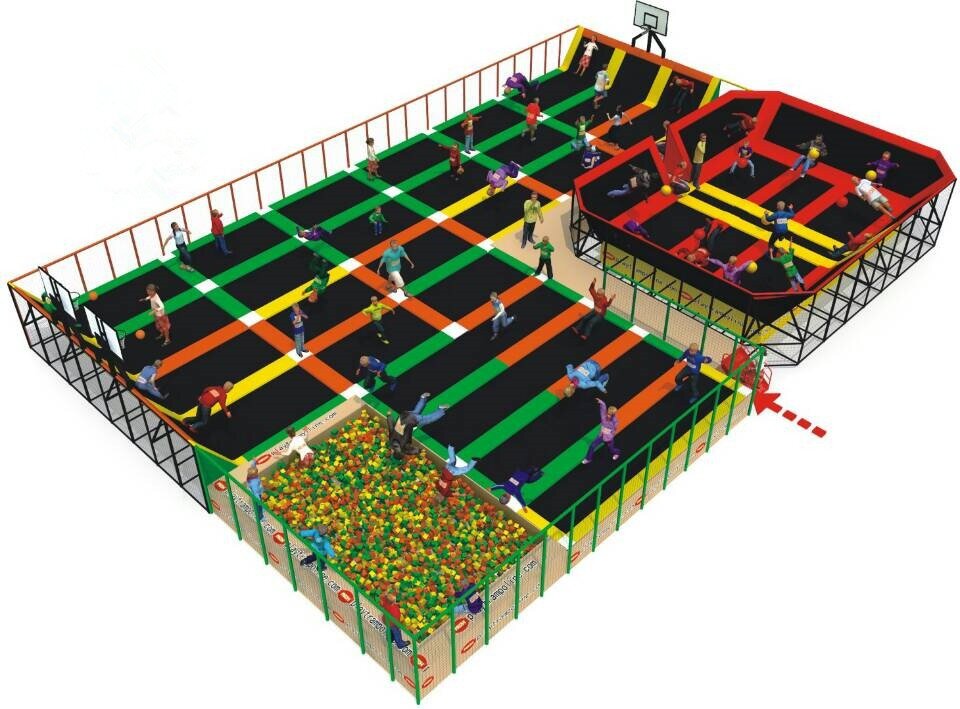
A commercial trampoline park main court: interconnected beds bordered by padded perimeter walls.
A commercial trampoline park is built from discrete activity zones. The mix depends on floor area, ceiling height, and the age profile of the local market, but the common ones recur across almost every project.
The main court - sometimes called the open jump area - is the largest single zone, a continuous grid of interconnected beds bordered by padded walls. It carries the most guests at once and sets the tone for how big the park feels when someone walks in. Around it sit the specialty zones.
A foam pit is a recessed or framed bay filled with foam cubes, fed by a runway of trampoline beds so jumpers can launch and land soft. Foam pits are maintenance-heavy - cubes compress, absorb dust, and need periodic topping up and cleaning - but they are one of the highest-demand features for teenagers and the reason many parks add an airbag alongside or instead. An airbag gives a similar soft landing with far less upkeep, though it costs more up front and needs a blower running during operating hours.
The dodgeball court is a bounded trampoline field with a center line and padded perimeter, and it is the single biggest driver of group bookings and league nights. Two courts let a park run tournaments without shutting down open jump. A slam-dunk lane pairs angled beds with basketball hoops at graduated heights, which reads as easy and photogenic and moves people through quickly.
A ninja course - warped wall, floating steps, cargo net, hanging obstacles - has migrated from a standalone attraction into a lane that many trampoline parks now run down one side of the building. It shares nothing structurally with the trampolines but competes for the same ceiling height and floor area. Performance trampolines, the deeper Olympic-style beds set into the floor, appeal to gymnasts and cheerleading athletes and justify a higher day rate for that corner of the park.
Smaller zones round out the mix: wall trampolines angled to bounce jumpers off a padded vertical surface, a battle beam over a foam pit or airbag, a toddler court with lower beds and softer springs walled off from the older-kid traffic, and a climbing or warrior feature bolted to the perimeter. Not every park runs all of them. A 6,000 sq ft site might carry a main court, one dodgeball court, a foam pit, and a small kids area. A 20,000 sq ft destination park can run a dozen distinct zones and still leave room for a cafe and party rooms.
Specialty zones - foam pit, dodgeball, and slam-dunk lanes - arranged around the main court.
Everything guests do happens on top of a steel frame they never see. That frame is where the long-term cost story lives, and it is the part of a trampoline park equipment quote worth reading closely.
Trampoline frames take repeated dynamic load - a full court can have forty people landing at slightly different moments, each transferring force into the same welded grid. Steel tube diameter and wall thickness decide how that load is carried over years of full-traffic operation. Industry-typical imported frames run around 40mm diameter with 1.5mm walls, which is adequate for lower-traffic sites. A heavier commercial spec runs 48mm x 2.2mm, and the difference does not show up on opening day. It shows up as frame wobble and, later, as fatigue cracking at the welds - the kind of thing that starts appearing somewhere around year three to five on lighter framing under commercial traffic.
Springs are the wear item. A trampoline park runs on tens of thousands of galvanized steel springs, and they stretch, lose tension, and eventually need replacement on a rolling schedule. Spring gauge and coil count per bed affect both bounce quality and how long each spring lasts before it goes soft. Beds themselves are woven polypropylene or a permatron-style mesh, UV-treated for indoor light exposure, stitched at the edges where they hook to the springs. The stitching is usually what fails first.
Powder coating on the frame is easy to overlook and expensive to ignore. Coating thickness - measured in microns - determines how the steel resists the humidity, sweat, and cleaning chemicals it lives with. A film around 40 to 60 microns is common. A heavier 80+ micron coat holds color and corrosion resistance longer in the warm, damp air a busy jump floor generates. Bare or thin-coated steel in that environment starts showing surface rust at the weld seams well before the frame is structurally done.
The safety padding is not an accessory. On a trampoline court the pads cover every frame rail, every spring bank, and every wall a jumper can hit, and they are the single component guests make hard contact with most often. Two things define a pad: the foam inside and the vinyl over it.
Foam is rated by density. Higher-density EVA foam holds its shape and its shock absorption under repeated impact; lower-density foam compresses, bottoms out, and stops protecting the steel underneath it. Lefunland builds its safety padding on 80-density EVA, against an industry-typical 40 to 50. The two look identical the day the park opens. The difference is that the denser foam is still doing its job after two years of a thousand landings a day, where the lighter foam has flattened at the high-contact edges and needs replacing.
Over the foam sits the vinyl - the PVC covering that takes the abrasion, the cleaning, and the occasional shoe. Covering thickness is measured in millimeters. A 0.45mm PVC skin resists tearing and scuffing longer than a thinner 0.35mm one, and torn vinyl is not cosmetic on a trampoline park - it exposes foam, traps moisture, and fails inspection.
Beyond the pads, the safety envelope of a trampoline park runs to enclosure netting, the spacing and height of perimeter walls, no-jump buffer zones between beds, and the padded transitions between different-height surfaces. The applicable standard for trampoline courts in the US is ASTM F2970, which covers structural design, netting, padding, signage, and operational rules. Lefunland manufactures to ASTM, EN1176, and IBC, and operates an SGS-authorized testing laboratory - meaning the company both builds the equipment and can test and issue inspection reports across the amusement equipment industry, not only for its own products.
Two trampoline parks with identical equipment lists can perform very differently depending on how the floor is arranged. Layout is where a building's constraints - column grid, ceiling height, entrance position, emergency exits - meet the zones.
Ceiling height is the first hard limit. Wall trampolines, performance beds, ninja warped walls, and any hanging obstacle all need clear vertical space, and a building with 14-foot ceilings simply cannot run the same program as one with 22 feet. High-clearance zones get placed under the tallest part of the roof. Foam pits and airbags need depth below or framing above, so their position is often dictated by the slab and the drainage as much as by traffic.
Sightlines drive the rest. Parents watching from a cafe or a seating rail want to see the toddler court and the main court without walking the floor, so those zones face the viewing area. Dodgeball and foam pit - the loud, high-energy features - sit deeper in. The entrance funnels guests past the counter and the grip-sock point before the floor opens up, and the exits stay clear of the busiest beds. Court sizing follows capacity math: bed count sets the maximum simultaneous jumpers, and staffing ratios and the local occupancy code set the number of monitors the layout has to support.
Higher equipment density raises the cost per square foot and also the supervision load. A tightly packed 4,000 sq ft park puts nearly every foot under structure, which reads as good value per foot of building but demands close monitoring. A 15,000 sq ft park intentionally leaves walk lanes, rest seating, and party rooms across a third or more of the floor, which lowers the per-square-foot equipment cost and spreads guests out. Both are right for their context. They produce different numbers on the quote.
Trampoline park equipment is quoted by the square foot of activity area, and for commercial-grade material the range starts from about $10 per sq ft and typically runs $10 to $15 - roughly $108 to $161 per square meter. That figure covers the steel structure, beds, springs, safety padding, netting, and the standard zones. Specialty features change it: an airbag, a full ninja lane, performance beds, or a large foam pit each add cost beyond the base court, and smaller footprints land at the top of the range because almost every foot is carrying structure.
Translated into whole projects, a smaller build under 5,000 sq ft generally falls in the $15K to $75K bracket for equipment, a mid-size 5,000 to 10,000 sq ft park in the $50K to $150K range, and a large 10,000+ sq ft destination park from $100K to $300K and up depending on the zone mix. Those are factory-direct, equipment-only figures - they do not include the building, the fit-out, sprinklers, HVAC, or local permitting.
The $10 to $15 range sits deliberately in the middle of the market. It is not the cheapest trampoline equipment available, and it is not premium-priced. It pairs the heavier material specs - 48mm x 2.2mm steel, 80+ micron coating, 80-density EVA, 0.45mm PVC - with mid-range pricing. Equipment built to a lighter spec can quote 15 percent under that and often does. Whether it is actually cheaper depends on when the frame, the springs, and the padding need replacing, which is a line item that shows up in year three or four rather than in the opening quote. For a fuller treatment of how equipment pricing is built up, see the indoor playground cost guide, and for how certification affects both safety and insurance, the safety standards guide.
Lefunland runs a 45-day production lead time on a typical trampoline park order, with 3D design worked out against the building's actual dimensions before anything is cut. The company has delivered 3,000+ projects across 60+ countries since 2009, manufacturing from a 70-acre facility, and has spent 16+ years as a principal drafting unit for China's national amusement equipment standards.
If you are working out the zone mix, the ceiling clearances, and the equipment budget for a specific building, Lefunland can turn your floor plan into a 3D layout and a factory-direct quote against real dimensions. Email contact@lefunland.com or reach the team on WhatsApp at +8613605727866. Request a quote with your building size and ceiling height, and you will get back a zone plan and equipment pricing built to ASTM F2970.
Copyright 2018-2026 © ShangHai Lefunland Children's Products Co.,Ltd. All Right Reserved
