



Powder Coating for Playground Equipment: Why Thickness Matters
A play center outside Houston sent us photos in their third year: orange streaks weeping down the legs of a climbing frame, a few bubbled patches near the floor anchors, rust creeping out from under the paint. The steel underneath was still sound. The coating had given out. When we asked for the original spec sheet, the powder coating line was blank - the quote had listed a color, not a thickness. That blank line is most of what a buyer needs to understand about powder coating on playground equipment. The finish you see is not decoration. It is the only barrier between commercial-grade steel and the humidity, hand sweat, spilled juice, and daily cleaning chemicals that soak an indoor play floor.

What powder coating on playground equipment actually does
Powder coating is not paint sprayed from a can. Dry pigment is charged, blown onto the bare steel, and then baked in an oven until it melts and fuses into a continuous shell. Done well, it wraps the tube - the flats, the curves, the welded joints, the cut ends. That shell does two jobs. It keeps oxygen and moisture off the steel so it cannot rust, and it holds color under the constant UV and abrasion of a working play floor.
The steel matters here too. Commercial frames run on 48mm x 2.2mm pipe, heavier wall than the 40mm x 1.5mm common on lighter-duty imports. But even good steel corrodes the moment its coating is breached. A thick, even finish is what keeps that breach from happening in the first place, and a thin one is where the trouble starts - usually at the edges and the welds, where coating tends to pull thin during application.
The thickness number: 80+ microns versus 40 to 60
Coating thickness is measured in microns. One micron is a thousandth of a millimeter, so the whole finish is about a tenth of a millimeter of material standing between the steel and the room. Lefunland specifies 80+ microns. A lot of equipment on the market runs 40 to 60. On opening day you cannot tell them apart. Both look glossy. Both feel smooth.
The gap shows up later, and it shows up first at the places coating is thinnest. Sharp edges and weld seams are where a 40-micron average often drops to 20 or less, because powder does not cling to corners the way it clings to a flat face. Those are exactly the points that take the most contact and hold the most moisture. Thicker overall coverage buys margin at those weak points. It also resists the small daily insults better - a stroller wheel dragged across a rail, a scrubbing pad with disinfectant on it, a decade of small hands. Color holds longer, chalking and fading come later, and the barrier stays intact through more abuse before steel is exposed.
| Coating detail | Lefunland | Industry-typical |
|---|---|---|
| Powder coating thickness | 80+ microns | 40-60 microns |
| Steel substrate | 48mm x 2.2mm pipe | 40mm x 1.5mm pipe |
| Where it fails first | edges and welds still covered | edges and welds thin out |
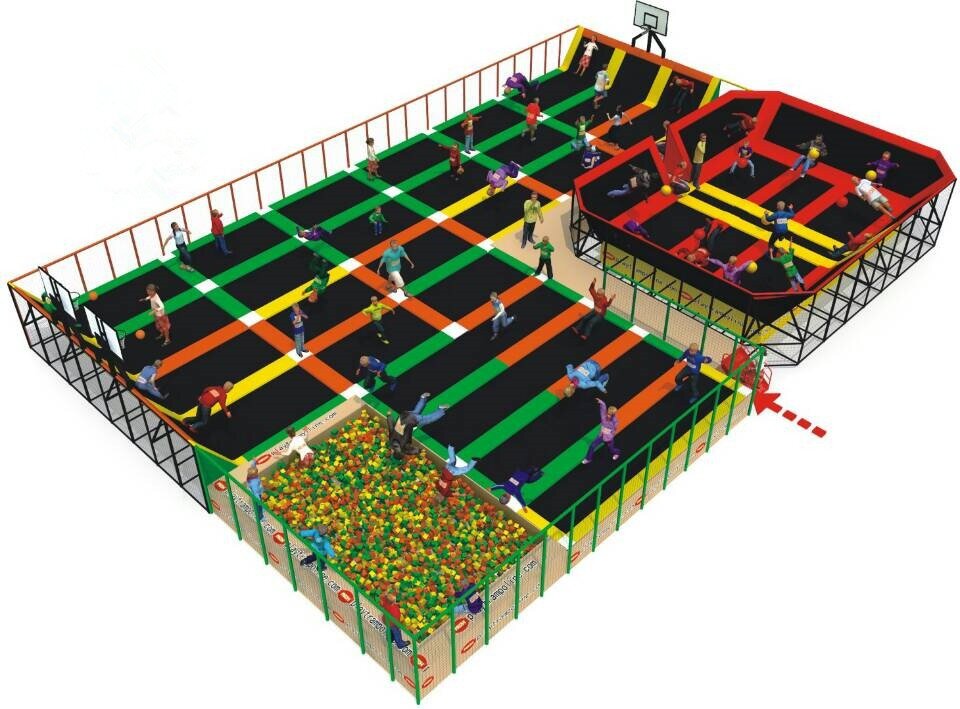
How powder coating playground equipment gets tested
Thickness is not something a buyer has to take on faith. It is measured with a magnetic or eddy-current gauge that reads the film in microns at any point on the frame, and it is checked at the edges and joints, not just the easy flat panels. Corrosion resistance gets pushed further in a salt-spray chamber, where a coated sample sits in a fine salt mist for hundreds of hours and is inspected for rust creep and blistering. Adhesion, impact, and gloss retention each have their own bench test.
Lefunland runs an SGS-authorized laboratory, which means the same testing that certifies the equipment can be run and reported on in house, for the wider amusement industry as well as for our own frames. That lab, plus 16+ years building commercial structures since 2009 and 3,000+ projects across 60+ countries, is why the coating number on a Lefunland quote is written down rather than left blank. A spec sheet that names microns can be verified. A spec sheet that names only a color cannot.
Where the number ends up mattering
Two frames that look identical on opening day can diverge sharply by year three. The one with a thin, uneven finish starts weeping rust at the anchors and welds, and touch-up paint on a live play floor is a poor and temporary fix. The one coated to 80+ microns is still holding color and holding the barrier. This is the same reason coating shows up in any honest conversation about total cost - a frame that has to be stripped and recoated, or replaced, in year four was never the cheaper frame. It is also why a routine wipe-down protocol protects a good coating for years; the finish and the cleaning schedule work together, a point we cover in the indoor playground equipment maintenance guide. For how coating fits alongside steel gauge, foam density, and PVC thickness, see the indoor playground equipment materials guide.
Talk to Lefunland
If you are comparing quotes and want the coating spec read against the steel and certification behind it, we are glad to walk through it. Lefunland builds factory-direct from a 70-acre facility, with pricing from $10 per sq ft for top-tier materials. Email contact@lefunland.com or reach us on WhatsApp at +8613605727866 to request a quote or a factory-direct quote on your project.
