Contact Number: +86 4006234566




A 6,500 sq ft play centre in outer-suburban Melbourne took delivery of two 40-ft high-cube containers on a Tuesday in March and opened to the public nineteen days later. Production ran 45 days. Sea freight from Ningbo to Melbourne took 22 days door to port. Customs and biosecurity release took four. That timeline is normal, and it is the part most first-time buyers of indoor playground equipment in Australia get wrong - not the equipment decision, the calendar around it. Australia sits far enough down the shipping lanes that a two-week slip in production becomes a five-week slip in opening.
Australia does not have a single standard that covers a commercial indoor play centre end to end. It has several that overlap, and which one a certifier or insurer leans on depends on what is in the room.
The AS 4685 series is the anchor document. It is the Australian adoption of the European EN 1176 family, and the technical content tracks closely: entrapment gaps, protrusion limits, fall heights, structural loading, impact-attenuating surfacing under AS 4422. Because AS 4685 was written primarily with public playground equipment in mind, indoor operators sometimes assume it does not reach them. Councils, certifiers and public-liability underwriters generally treat it as the reference anyway. Equipment already certified to EN 1176 answers most of what an Australian assessor will ask, because the clause structure is the same.
Trampoline parks are the exception. There is no dedicated Australian standard for commercial trampoline courts, so the market has settled on ASTM F2970 out of the United States, sometimes alongside AS 3533 for the amusement-device side. An operator putting in performance trampolines, tumble tracks and foam pits will usually be asked for F2970 documentation.
The National Construction Code governs the building the equipment sits inside - egress widths, fire separation, occupancy load, accessible paths. Equipment certified to ASTM, EN 1176 and IBC covers the structure and the play elements. It does not cover the fitout. Those are separate approvals through the local council or a private certifier, and they run on their own clock.
Multi-level structure with netted enclosures - the configuration most Australian centres specify for a 5,000 to 8,000 sq ft footprint.
Then there is state law. Workplace health and safety is administered state by state, so a centre in Queensland and a centre in Victoria answer to different regulators on staffing, incident reporting and equipment inspection records, even with identical equipment on the floor. Written commissioning documentation and an annual inspection regime carry weight in both.
Equipment ships knocked down. Steel tube, panels, netting, foam and plastic components travel flat or nested, and a 6,000 to 8,000 sq ft fitout typically fills two 40-ft high-cube containers. Larger builds with a ropes course or trampoline zone run to three or four.
Transit from the main Chinese export ports to Sydney, Melbourne, Brisbane, Adelaide, Fremantle and Port Adelaide is roughly 16 to 26 days depending on the service and whether the vessel transships through Singapore or Port Klang. Add the 45-day production lead time and a realistic order-to-wharf window is nine to ten weeks. Direct services to the eastern seaboard are the fastest; Perth and Darwin usually add a leg.
Two things routinely surprise Australian importers.
The first is biosecurity. The Department of Agriculture, Fisheries and Forestry screens incoming containers hard, and playground shipments carry the two things it looks for: timber packing and residual soil or plant material on container floors. Timber crating and dunnage must be ISPM 15 treated and legibly marked. A container that arrives with unmarked timber, or that gets pulled for inspection and fails, sits on the wharf accruing storage while it is fumigated or the packing is destroyed. That is a two-week hole in an opening schedule, and it is entirely avoidable at the packing stage.
The second is the duty position. Under the China-Australia Free Trade Agreement, goods of Chinese origin currently enter Australia at zero tariff provided a valid Certificate of Origin or Declaration of Origin accompanies the shipment. Without that paperwork the general rate applies. GST at 10 percent is calculated on the customs value plus duty plus freight and insurance, and is recoverable by a GST-registered business through the BAS. The number that matters for cash flow is not the GST - it is the timing, because it is payable at clearance and recovered later.
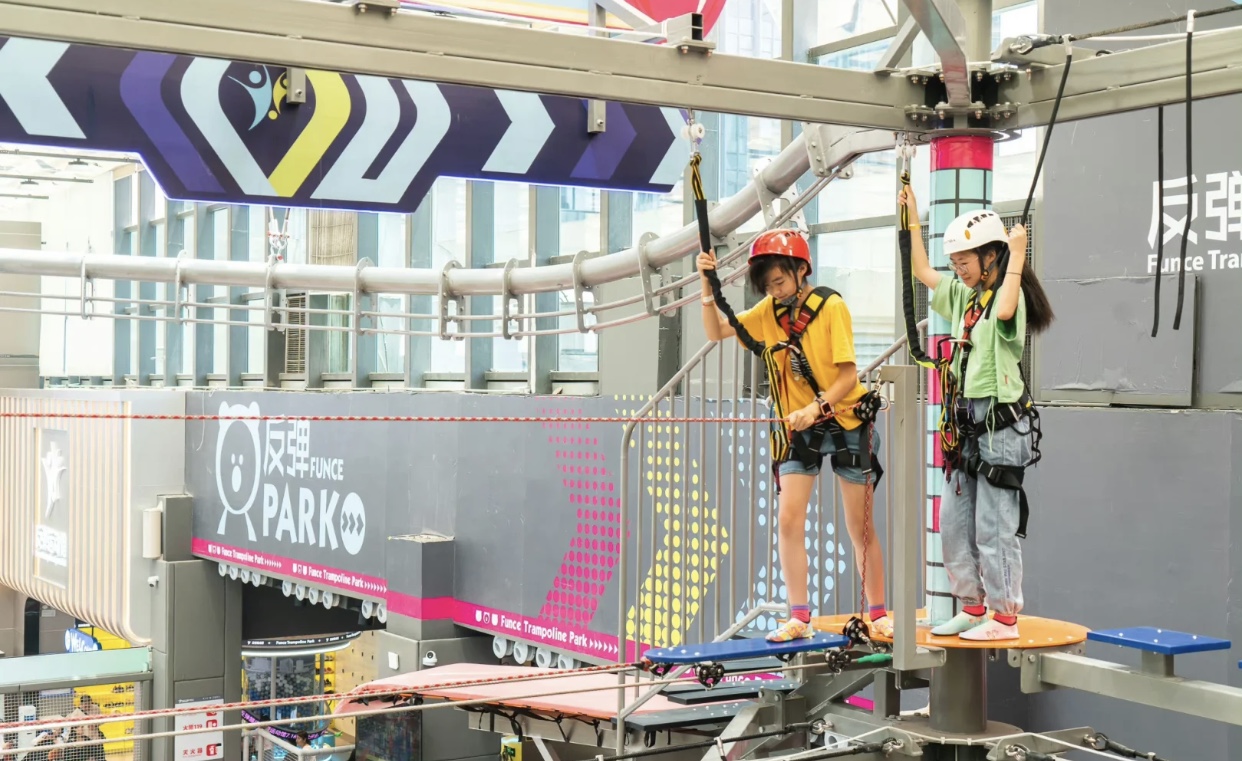
Frame construction is visible before soft covering goes on: 48mm x 2.2mm steel, 80+ micron powder coating.
Sea freight to Australia is charged on volume, not on how good the steel is. That changes the arithmetic in a way buyers in shorter-haul markets do not have to think about.
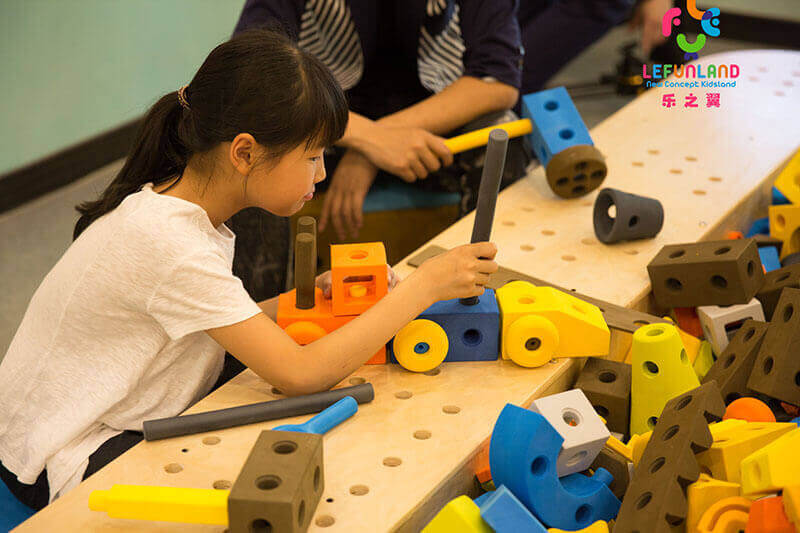
Lefunland builds on 48mm x 2.2mm steel tube where much of the imported market runs 40mm x 1.5mm. Powder coating goes on at 80+ microns against a 40 to 60 micron norm. EVA foam is 80-density, PVC covering 0.45mm. Those specifications add mass but almost no cube, so the freight cost per container is close to identical whichever grade is inside it. The heavier build lands in Australia for very nearly the same shipping spend.
That matters more here than elsewhere because replacement is expensive. A worn slide panel in a Melbourne centre is not a next-day part. It is an air-freight charge or a wait for the next consolidation. Equipment that needs component replacement at year four in Australia costs the operator considerably more than the same failure would in a market with a local parts depot. Better material grade is worth more the further the site is from the factory.
Equipment pricing starts from $10 per sq ft factory-direct, with most commercial fitouts landing in the $10 to $15 range before freight, duty and installation. Density drives where a project sits in that band - a compact 3,500 sq ft site carries structure across nearly every square foot and quotes at the top, while a 12,000 sq ft centre with party rooms and walk zones sits at the bottom.
Toddler zone in 80-density EVA with 0.45mm PVC covering, specified separately from the main structure.
Lefunland has delivered more than 3,000 projects across 60+ countries and works factory-direct - the same team that engineers the drawings runs the build. For Australian projects, installation supervisors travel to site and lead the assembly, working alongside local labour hired by the operator.
That split exists because of the licensing regime. Electrical work in Australia must be carried out by a locally licensed electrician. Anyone working above 2 metres needs the relevant working-at-heights competency, and everyone on a construction site needs a White Card. A visiting installation crew cannot legally do the electrical connections or sign off the site induction, so the practical model is supervision plus local hands. Operators who book their sparky and their labour hire before the container lands finish assembly in two to three weeks on a mid-size centre. Operators who start looking after the container arrives add a fortnight.
Anchoring is the other item worth resolving early. Slab thickness and reinforcement determine the anchor detail, and that information needs to reach the factory during engineering, not on arrival. A slab that turns out to be thinner than assumed means redesigned base plates and a delay measured in weeks.
| Document | Why it is needed |
|---|---|
| EN 1176 / ASTM F1487 test certificates with numbers | Certifier and public-liability underwriter review |
| ASTM F2970 report (trampoline zones only) | No Australian equivalent standard exists |
| Certificate of Origin / Declaration of Origin | ChAFTA preferential duty rate at clearance |
| ISPM 15 treatment marks on timber packing | Biosecurity release without fumigation |
| Fire-retardant and flame-spread reports for foam and vinyl | NCC fitout approval |
| Structural calculations and anchor detail | Private certifier sign-off |
| Commissioning and annual inspection records | State WHS regulator and insurer |
Certificate numbers matter more than certificate logos. A logo on a brochure is not a document a certifier can look up, and the gap between the two is where most Australian approval delays start. More detail on how the standards families compare is in our guide to ASTM F1487 vs EN 1176 safety standards, and the production side is covered in equipment lead time from order to opening.
Lefunland has been manufacturing commercial indoor play equipment since 2009 - 16+ years, 3,000+ projects delivered in 60+ countries, from a 70-acre factory in Dongyang, Zhejiang. The company is a principal drafting unit for China's national amusement equipment standards and operates an SGS-authorized laboratory that tests and issues inspection reports for the wider amusement equipment industry.
Send your floor plan, ceiling height and slab details and we will come back with a 3D design and a factory-direct quote, including container count and an indicative freight window to your nearest Australian port.
Request a quote and we will scope the build against AS 4685 and the standards your certifier will be reading.
Copyright 2018-2026 © ShangHai Lefunland Children's Products Co.,Ltd. All Right Reserved
